


Some places are hard to describe without sounding as if you’re making it up. Sri Lanka is full of them.
On one island you can stand beside a tree planted in 288 BC, climb a staircase that once led into a lion’s mouth, and queue to honour a tooth that decided who ruled the country. Wild elephants hold a yearly get-together at a reservoir built 1,700 years ago, and four religions claim the same footprint on top of a mountain.
Here are 10 things in Sri Lanka that sound made up but are completely real, in the order you’d meet them on a classic loop of the island: from the ancient cities of the north, through the tea hills, down to the beaches of the south.
The route at a glance: Anuradhapura → Sigiriya → Minneriya → Kandy → the tea country → Adam’s Peak → Ella → Yala → Mirissa → the south coast. Allow about two weeks if you don’t want to rush.
Anuradhapura: a 2,300-year-old tree that replaced its own parent

Anuradhapura, Sri Lanka’s first great capital, was a seat of kings for well over a thousand years. Its most famous resident is a tree.
The Jaya Sri Maha Bodhi is a sacred fig grown from a branch of the tree in Bodh Gaya, India, under which the Buddha is said to have attained enlightenment. According to the Mahavamsa, the island’s ancient chronicle, Emperor Ashoka’s daughter, the nun Sanghamitta, brought the branch over and it was planted in 288 BC. Guinness World Records lists it as the oldest known tree planted by a human.
Now the part that sounds made up. The original tree in India didn’t survive, and the one growing at Bodh Gaya today is widely reported to have been planted in 1881 from a cutting of this one. The child ended up replacing its parent.
Go early in the morning, when pilgrims arrive with flowers and the air is still cool. As at any temple in Sri Lanka, cover your shoulders and knees, and take off your shoes and hat before you go in.
Sigiriya: a palace you entered through a lion’s mouth

In AD 477 a prince called Kashyapa seized the throne and had his father walled up alive. Then, afraid his half-brother would come back for revenge, he moved the whole capital to the top of a granite rock about 180 metres high.
He built a palace on the summit and, halfway up, a gateway shaped like an enormous crouching lion. Visitors climbed a staircase between its paws and into its open mouth. The head collapsed long ago, but the two giant paws are still there, and they’re why Sigiriya is known as Lion Rock.
Below them runs the Mirror Wall, once polished so smoothly that the king could see his reflection in it. From around the 8th century, visitors scratched more than 1,500 poems into it, most of them swooning over the painted women on the rock above. They may be the world’s oldest tourist reviews. One visitor, a man called Budal, simply noted that he’d come with hundreds of people and, since everyone else had written a poem, he hadn’t.
The half-brother did come back, in 495. Kashyapa’s army deserted him in battle and he took his own life. Writing on the wall is banned now, so save your review for the comments.
Minneriya: hundreds of wild elephants meet at a 1,700-year-old reservoir
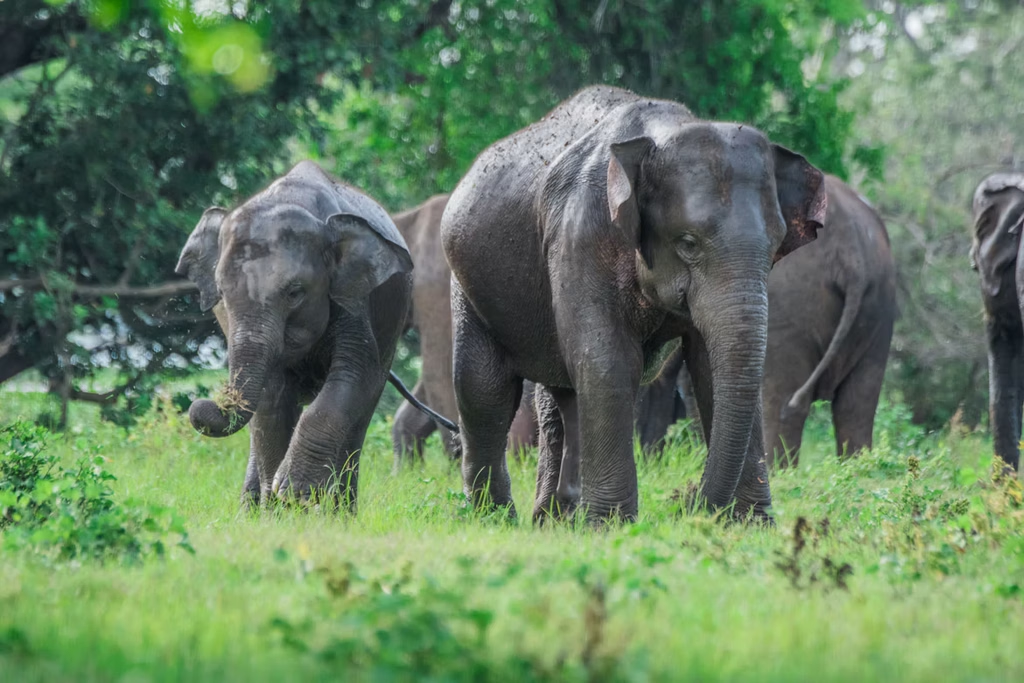
Image by Udara Karunarathna
A short drive from Sigiriya lies the Minneriya reservoir, built by King Mahasen in the 3rd century AD. Every dry season its water level drops, the old lakebed reappears and fresh grass sprouts all over it. Elephants from the surrounding forests come to eat it, and by around September more than 400 can be grazing there together.
It’s known simply as the Gathering, and it’s often described as the largest yearly meeting of Asian elephants anywhere in the world.
A few years ago it almost disappeared. After a new reservoir upstream was finished in 2018, water kept being released into Minneriya in the dry season, drowning the grass. A count of 402 elephants in September 2017 fell to just 20 in September 2021. A Sri Lankan wildlife charity took the authorities to court, and in late 2025 the authorities promised the court they would restore the reservoir’s natural rise and fall.
Go between July and October and book an afternoon safari, when the herds wander out to the grass as the day cools.
Kandy: a tooth that decided who ruled the island

Kandy’s Temple of the Sacred Tooth Relic holds what Buddhists revere as a tooth of the Buddha. Legend says it reached the island in the 4th century, smuggled across the sea by a princess called Hemamali, who hid it in her hair.
From then on, whoever kept the tooth was seen as the rightful ruler. So the relic moved whenever the capital did, always housed next to the royal palace, and at one point it was hidden inside a grinding stone to keep it safe. Today it sits inside seven golden caskets, and every July or August the city honours it with the Esala Perahera, a night-time parade of drummers, dancers and elephants.
How seriously do people take it? When the relic went on public view in April 2025, around 450,000 people came in a single day, and the queue stretched for nearly 10 kilometres.
The tea country: a coffee island until a fungus ate it

Ceylon tea is so famous that the name outlived the country: Ceylon became Sri Lanka in 1972, but the tea kept its old label. Yet for most of the 1800s, the island’s hills were covered in coffee.
In 1869 a fungus called coffee rust turned up and spread from estate to estate. Within about 20 years the coffee industry had collapsed. Luckily, a Scot called James Taylor had already planted tea on 19 acres of the Loolecondera estate near Kandy in 1867, and in 1872 he opened the island’s first tea factory there. Desperate planters copied him, burned millions of diseased coffee bushes and planted tea instead.
A Glasgow grocer called Thomas Lipton then bought up former coffee estates and turned Ceylon tea into a household name. Today the hills around Kandy, Nuwara Eliya and Ella are striped with tea bushes, and many estates will show you round the factory and let you taste the tea where it’s made.
Adam’s Peak: a footprint four religions say is theirs

Near the summit of this 2,243-metre mountain is a rock with a 1.8-metre hollow shaped like a footprint. Whose foot made it depends on who you ask.
Buddhists say it’s the Buddha’s left foot. Many Hindus say it belongs to Shiva, and the mountain’s Tamil name means Mountain of Shiva’s Light. Some Muslim and Christian traditions say it’s where Adam first stood after being thrown out of paradise, which is how the mountain got its English name, while some Christians credit St Thomas instead.
Pilgrims climb around 5,500 steps through the night, mostly between December and May, when the path is lit. The aim is to reach the top for sunrise, when the mountain throws a near-perfect triangular shadow across the land below. The traveller Ibn Battuta made the climb in 1344 and described chains fixed to the rock to help pilgrims up. At the top there’s a bell, and tradition says you ring it once for every time you’ve made the climb.
Ella: the famous bridge with a story nobody can prove

The Nine Arch Bridge carries the railway 24 metres above a jungle ravine near Ella. When a blue train rolls across it, every phone in the valley comes out.
Ask how it was built and you’ll probably hear this: when the First World War broke out, the steel meant for the bridge was shipped off for the war effort, so a local builder called P. K. Appuhami built it from stone, brick and cement, without a single steel girder.
The engineering records tell a plainer story. The bridge was designed by a British railway engineer, Harold Cuthbert Marwood, built by local workers from concrete blocks and finished in 1919, and a 1923 report sets out its plans and drawings. There’s no documented evidence that Appuhami was involved. The legend has outlived the paperwork anyway, and you’ll still hear it told on the bridge.
Trains cross several times a day, so ask in Ella for the times, and stay well clear of the track when one is due.
Yala: one of the best places on Earth to spot a leopard

Sri Lanka has no wild tigers or lions, so the leopard rules the food chain, and the island has its own subspecies. In Yala National Park, in the dry south-east, they’re unusually easy to see. In Block 1, the most visited part of the park, there’s roughly one leopard for every 1.8 square kilometres (0.7 square miles).
The catch is that everyone knows it. When a leopard is spotted, dozens of jeeps can gather round it within minutes. Book an early-morning safari, ask your driver about the quieter blocks, and check dates before you go: Block 1 usually closes for a spell each year, typically around September and October.
Mirissa: the biggest animal that has ever lived, just off the beach

Blue whales are the largest animals known to have ever lived. Off Sri Lanka’s southern tip, deep water lies unusually close to the shore, and between November and April the whales pass near enough to be seen on a morning boat trip from Mirissa, a small fishing port with a surf beach.
December to March usually brings the calmest seas. Sightings are never guaranteed, so choose an operator that keeps a respectful distance rather than one that chases the whales.
The south coast: an “ancient” tradition younger than your grandparents

A fisherman perched on a pole in the surf is probably Sri Lanka’s most famous postcard, and it looks centuries old. It isn’t. Stilt fishing is generally thought to have started during or just after the Second World War, when food was short and the best spots on the rocks were crowded, so men drove poles into the reef and fished from a crossbar.
You’ll find it along a short stretch of coast between Unawatuna and Weligama, around Koggala and Ahangama. Catches are smaller now, and many of the men on the poles are there for the tourists rather than the fish: they’ll pose for a photo for a fee, and a few aren’t fishermen at all. To see the real thing, come at dawn.
Which of these things in Sri Lanka would you believe without seeing it?
A tree that replaced its own parent, a staircase through a lion’s mouth, a tooth that crowned kings and a bridge with two origin stories: Sri Lanka packs a lot of “that can’t be true” into one island. Which would you most like to see for yourself? Tell us in the comments.
If you’re planning the trip, add World’s End in Horton Plains, where the land drops more than 800 metres in one go. It’s one of our 12 real fairytale places. And pin this post so it’s ready when you book.